

Lesson: Musical Modes
by 8notes.com
We've already looked at the major scale and the
minor scale. Now it's time to look at a different kind of scale, known as a mode.
Writing a tune in modes is both an ancient and a modern idea. It was the most common form of scale before the 17th century, and has been popular with composers once again, since around the end of the 19th century.
So what is a mode?
Let's look back to our C major scale.

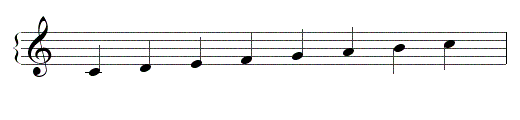
Using just these same 7 notes - C D E F G A and B, it is possible to create 7 new modal scales. It all depends where you start. for example, let's start on the D instead of C:

We're still using only those same seven notes, but we're starting and ending on the second note or supertonic of C major. That's a mode called the Dorian Mode.
For more on the Dorian mode, check out our page featuring examples of pieces in the Dorian Mode from Classical, Traditional, Jazz and Pop repertoire.
So that's the Dorian, which starts on D. As you can see below, there's a mode starting on each of the other notes too:
Starting on the E (the third, or mediant of C major) we get the Phrygian mode

Starting on the F (the fourth, or subdominant of C major) we get the Lydian mode

Starting on the G (the fifth, or dominant of C major) we get the Mixolydian mode

Starting on the A (the sixth, or submediant dominant of C major) we get the Aeolian mode

Starting on the B (the seventh, or leading tone of C major) we get the Locrian mode

That's six modes so far. The seventh is the one starting on the C itself. That's known as the Ionian mode. But as it's a mode that contains exactly the same notes as C major itself, it's an unusual way to describe a scale these days.
There are two other modes we can think of as major modes, the Mixolydian and the Lydian:
Here is C Mixolydian, which is essentially the major scale, but with a flat 7th note:

and here is C Lydian, which is the major scale, but with sharpened 4th. This scale is often used in film music.

The Aeolian mode is also known as the natural minor scale. It is the scale you use on the way down when you play a melodic minor scale. Here is C Aeolian

The other minor mode scale is the Dorian, which is the same as the Aeolian, except for the sharpened 6th note of the scale. In scales starting on C, that means the Ab we found in C Aeolian scale becomes an A natural in C Dorian:


and finally, the Locrian mode. As with the two minor mode scales, there is only one note difference between the Phrygian mode and the Locrian mode, can you spot it?
It's the 5th note of the scale. The G natural in C Phrygian becomes a G flat in G Locrian.

Let's look at the following melody as an example:
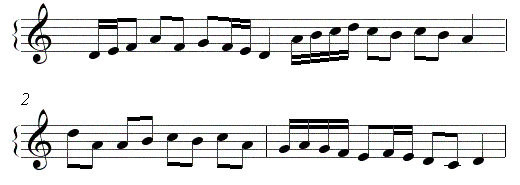
Several clues give away D as an important note in this melody, not least that it begins and ends with a D. Of these the ending note is far more important - melodies do often (but by no means always) end on the key note. The other prominent note in the piece is A which is the dominant (or 5th) of D - an important note to any kind of D scale (except for the quite rare Locrian mode).
There are no F sharps or C sharps, so that rules out D major as an option.
There is also no Bb, so that rules out both the harmonic and the melodic minor scale, so it's likely to be a mode. Checking the modes starting on D we can see that the notes all belong to the D Dorian scale, so it must be D Dorian mode.
Writing a tune in modes is both an ancient and a modern idea. It was the most common form of scale before the 17th century, and has been popular with composers once again, since around the end of the 19th century.
So what is a mode?
Let's look back to our C major scale.
Using just these same 7 notes - C D E F G A and B, it is possible to create 7 new modal scales. It all depends where you start. for example, let's start on the D instead of C:
We're still using only those same seven notes, but we're starting and ending on the second note or supertonic of C major. That's a mode called the Dorian Mode.
For more on the Dorian mode, check out our page featuring examples of pieces in the Dorian Mode from Classical, Traditional, Jazz and Pop repertoire.
So that's the Dorian, which starts on D. As you can see below, there's a mode starting on each of the other notes too:
Starting on the E (the third, or mediant of C major) we get the Phrygian mode
Starting on the F (the fourth, or subdominant of C major) we get the Lydian mode
Starting on the G (the fifth, or dominant of C major) we get the Mixolydian mode
Starting on the A (the sixth, or submediant dominant of C major) we get the Aeolian mode
Starting on the B (the seventh, or leading tone of C major) we get the Locrian mode
That's six modes so far. The seventh is the one starting on the C itself. That's known as the Ionian mode. But as it's a mode that contains exactly the same notes as C major itself, it's an unusual way to describe a scale these days.
Comparing modes
Now let's transpose each of the above modes so they all start on the note C. That way we can compare them more easily.Major modes
Here's C Ionian, our friend the major scale:
There are two other modes we can think of as major modes, the Mixolydian and the Lydian:
Here is C Mixolydian, which is essentially the major scale, but with a flat 7th note:
and here is C Lydian, which is the major scale, but with sharpened 4th. This scale is often used in film music.
Minor Modes
There are also two modes we can think of as minor modes:The Aeolian mode is also known as the natural minor scale. It is the scale you use on the way down when you play a melodic minor scale. Here is C Aeolian
The other minor mode scale is the Dorian, which is the same as the Aeolian, except for the sharpened 6th note of the scale. In scales starting on C, that means the Ab we found in C Aeolian scale becomes an A natural in C Dorian:
Exotic modes
Finally, there are two more unusual modes, which we've called exotic modes, both of which start with that strange sounding minor second. The Phrygian mode:
and finally, the Locrian mode. As with the two minor mode scales, there is only one note difference between the Phrygian mode and the Locrian mode, can you spot it?
It's the 5th note of the scale. The G natural in C Phrygian becomes a G flat in G Locrian.
Recognising modes
Let's say you are given a piece that uses just the white notes of the piano - C D E F G A and B. How can you tell whether it is in C major, A minor, or if it's in a mode?Let's look at the following melody as an example:
Several clues give away D as an important note in this melody, not least that it begins and ends with a D. Of these the ending note is far more important - melodies do often (but by no means always) end on the key note. The other prominent note in the piece is A which is the dominant (or 5th) of D - an important note to any kind of D scale (except for the quite rare Locrian mode).
There are no F sharps or C sharps, so that rules out D major as an option.
There is also no Bb, so that rules out both the harmonic and the melodic minor scale, so it's likely to be a mode. Checking the modes starting on D we can see that the notes all belong to the D Dorian scale, so it must be D Dorian mode.