

Jean Sibelius Biography - A Very Quick Guide
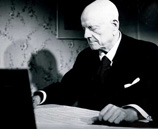

Johan (Jean) Julius Christian Sibelius (December 8, 1865 – September 20, 1957) was a Finnish composer of classical music. Together with the work of Johan Ludvig Runeberg, Sibelius' music is synonymous with Finnish national identity.
Jean Sibelius was born in 1865 into a Finland-Swedish family in Hämeenlinna in the Russian Grand Duchy of Finland. His family consciously decided to send Jean to an important Finnish language school. This should be seen as part of the larger rise of the Fennoman movement, an expression of Romantic Nationalism which was to become a crucial part of Sibelius' artistic output and politics.
His most famous compositions are probably Finlandia, Valse Triste, the violin concerto, the Karelia suite and The swan of Tuonela (a movement from his Lemminkäinen suite), but he wrote much else besides, including other pieces inspired by the Kalevala, seven numbered symphonies, over a hundred songs for voice and piano, incidental music for 13 separate plays, an opera (Jungfrun i tornet, which remains unpublished), chamber music including a string quartet, piano music, 21 separate publications of choral music, and Masonic ritual music.
Sibelius' musical style
Jean Sibelius was part of a wave of composers who accepted the norms of late 19th Century composition, but sought to radically simplify the internal construction of the music. Like Antonin Dvorák this led him to seek idiomatic melodies and developmental procedures. He was influenced by Ferruccio Busoni and Peter Tchaikovsky, particularly in his unumbered choral symphony Kullervo, from 1891, through his Violin Concerto of 1903. However, he progressively stripped away formal markers of the sonata form in his work, and pursued the idea of continuously developing cells and fragments until coming to a grand statement at the end. The synthesis was often so complete that it was thought that he began from the finished statement and worked backwards.
Sibelius built much of his music with melodies that have very powerful modal implications, and that are drawn out over a number of notes. He preferred simple harmonization with some form of long sustained note underneath, called a pedal after organ pedals that produce such low sustained sounds. He stated 'music often loses its way without a pedal.' Because of this, Sibelius' music is sometimes considered insufficiently complex, but he was immediately respected by his peers, including Gustav Mahler. Later in life he was championed by critic Olin Downes but attacked by composer-critic Virgil Thomson.
Sibelius over time sought to use new chord patterns, including naked tritones (see harmony) and bare melodic structures to build long movements of music, in a manner similar to Haydn's use of built-in dissonances. He would often alternate melodic sections with blaring brass chords that swell and fade away, or underpin his music with repeating figures which push against the melody and counter-melody. His work is rich with literary reference, even when not explicit. The second symphony has a section based on Don Giovanni sneaking by moonlight, while the stark fourth symphony combines work for a planned 'Mountain' symphony with a tone poem based on Edgar Allan Poe's The Raven. He also wrote several tone poems based on Finnish poetry, beginning with the early 'En Saga' and culminating in two late tone poems.
He published only a few minor pieces after 1925, and said he destroyed the score for a completed 8th numbered symphony. His last large works were the symphonies 6 and 7, incidental music for 'The Tempest' and the symphonic poem 'Tapiola'. For nearly the last thirty years in his life (primarily after World War I and an operation for suspected throat cancer), Sibelius avoided talking about his music and composed nearly nothing.
Sibelius has fallen in and out of fashion, but remains one of the most popular 20th century symphonists, with complete cycles of his symphonies being recorded even today. In his own time, however, he focused far more on the more profitable chamber music for home use, and occasionally on works for the stage. Currently Simon Rattle, Lorin Maazel and David Allan Miller are considered major exponents of his work.
Works
- Finlandia (1899)
- Viisi joululaulua, opus 1, five Christmas songs (1895-1913)
- Jääkärimarssi (1915)
- Karelia suite (1893)
- Kullervo (1892)
- Lemminkäinen suite (1893)
- Porilaisten marssi (1900)
- Violin Concerto in D minor, opus 47 (1904)
- Symphony no. 1 in E minor, opus 39 (1899)
- Symphony no. 2 in D major, opus 43 (1902)
- Symphony no. 3 in C major, opus 52 (1906)
- Symphony no. 4 in A minor, opus 64 (1911)
- Symphony no. 5 in E flat major, opus 82 (1915 revised 1916 and 1919)
- Symphony no. 6 in D minor, opus 104 (1923)
- Symphony no. 7 in C major, opus 105 (1924)
- Symphony no. 8 (1929, completed and then destroyed by Sibelius, mentioned in a letter to Olin Downes in 1929)
- Voces intimae, a string quartet (1909)
Sibelius (as reported in the Manchester Guardian newspaper in 1958) summed up the style of his later works by saying that while other composers were engaged in manufacturing cocktails, he offered the public pure cold water.
External links
- Sibelius link collection (http://www.helsinki.fi/kasv/nokol/sibelius.html)
- Sibelius biography (http://www.abo.fi/fak/hf/musik/Sibelius/EN/)