

Ferruccio Busoni Biography - A Very Quick Guide
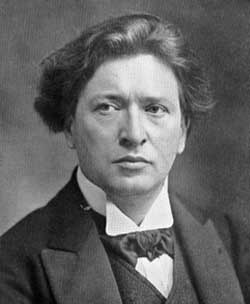
Artist:
Ferruccio Busoni
Born:
1 April 1866
Died:
27 July 1924
Ferruccio Busoni (1866–1924) was born in Empoli, Italy, the only child of two professional musicians - an Italian clarinetist father and an Italian-German pianist mother. Raised mostly in Trieste, he showed early talent and made his public piano debut at age seven. As a young prodigy he performed his own works in Vienna, where he met Liszt, Brahms and Rubinstein. After brief studies in Graz and Leipzig, Busoni held teaching posts in Helsinki (where he met his wife, Gerda Sjöstrand), Moscow, and the United States, where he also toured as a virtuoso pianist.
In 1894 Busoni settled in Berlin, becoming active as a pianist, conductor and teacher. He championed new music and led influential masterclasses in Weimar, Vienna and Basel; among his pupils were Egon Petri and, indirectly, Claudio Arrau. His Sketch of a New Aesthetic of Music (1907) argued for greater musical freedom and anticipated future developments such as microtonality and electronic sound, influencing students including Russolo, Grainger and Varèse. During World War I he lived in Bologna and Zürich before returning to Berlin in 1920. He taught composition until his death in 1924 from kidney disease. Busoni is commemorated by memorial plaques and by the Ferruccio Busoni International Piano Competition.
Busoni’s Music
Most of Busoni’s output is for piano, characterised by contrapuntal complexity, bold harmony and a distinctive, often ambiguous tonal language. His music shows the influence of Bach and Liszt, and he is often seen as a precursor of neoclassicism. Many works reimagine earlier music, including his celebrated piano transcriptions of Bach’s organ and violin pieces, notably the Chaconne and Toccata and Fugue in D minor. His largest solo piano work, the Fantasia contrappuntistica (1910), is a vast fantasia on Bach’s unfinished final fugue.
Busoni also composed demanding concertos - including the monumental Piano Concerto (1904) with male chorus - and several operas, among them Die Brautwahl, Arlecchino, and the unfinished Doktor Faust, completed after his death. His orchestral Turandot Suite later became the basis for an opera. As an editor, he produced influential but controversial editions of Bach and other composers, adding interpretive markings and performance guidance. Though his own recordings are limited and their accuracy debated, Busoni remains a pivotal figure in early modern music, admired for his pianism, his radical musical ideas and his innovative approach to tradition.
In 1894 Busoni settled in Berlin, becoming active as a pianist, conductor and teacher. He championed new music and led influential masterclasses in Weimar, Vienna and Basel; among his pupils were Egon Petri and, indirectly, Claudio Arrau. His Sketch of a New Aesthetic of Music (1907) argued for greater musical freedom and anticipated future developments such as microtonality and electronic sound, influencing students including Russolo, Grainger and Varèse. During World War I he lived in Bologna and Zürich before returning to Berlin in 1920. He taught composition until his death in 1924 from kidney disease. Busoni is commemorated by memorial plaques and by the Ferruccio Busoni International Piano Competition.
Busoni’s Music
Most of Busoni’s output is for piano, characterised by contrapuntal complexity, bold harmony and a distinctive, often ambiguous tonal language. His music shows the influence of Bach and Liszt, and he is often seen as a precursor of neoclassicism. Many works reimagine earlier music, including his celebrated piano transcriptions of Bach’s organ and violin pieces, notably the Chaconne and Toccata and Fugue in D minor. His largest solo piano work, the Fantasia contrappuntistica (1910), is a vast fantasia on Bach’s unfinished final fugue.
Busoni also composed demanding concertos - including the monumental Piano Concerto (1904) with male chorus - and several operas, among them Die Brautwahl, Arlecchino, and the unfinished Doktor Faust, completed after his death. His orchestral Turandot Suite later became the basis for an opera. As an editor, he produced influential but controversial editions of Bach and other composers, adding interpretive markings and performance guidance. Though his own recordings are limited and their accuracy debated, Busoni remains a pivotal figure in early modern music, admired for his pianism, his radical musical ideas and his innovative approach to tradition.
Top Pieces on 8notes by Ferruccio Busoni