

Richard Strauss - Biography
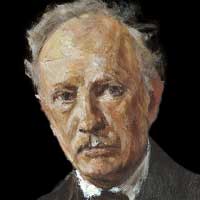

Richard Strauss Biography

Richard Strauss (June 11, 1864 – September 8, 1949) was a German composer of classical music particularly noted for his tone poems and operas. He was also a noted conductor.
He was born on June 11, 1864 in Munich, Germany, the son of Franz Strauss who was the principal French horn player at the Court Opera in Munich. He received a thorough, but conservative, musical education from his father in his youth, and began to compose at a very early age. In 1882 he entered Munich University, but left a year later to go to Berlin. There he studied briefly before securing a post as assistant conductor to Hans von Bülow taking over from him at Munich when he resigned in 1885. His compositions around this time were quite conservative, in the style of Robert Schumann or Felix Mendelssohn, true to his father's teachings. His Horn Concerto No. 1 from this period is of note and is still regularly played. Strauss' style began to change when he met Alexander Ritter, a noted violinist and the husband of one of Richard Wagner's nieces. It was he who first got Strauss seriously interested in the music of Wagner.
| Contents |
Tone poems
This newly found interest resulted in what is widely regarded as Strauss' first piece to show his mature personality, the tone poem Don Juan. When this was premiered in 1889, half of the audience cheered while the other half booed. Strauss knew he had found his own musical voice, saying 'I now comfort myself with the knowledge that I am on the road I want to take, fully conscious that there never has been an artist not considered crazy by thousands of his fellow men.' Strauss went on to write a series of other tone poems, including Tod und Verklärung (Death and Transfiguration, 1888–89), Till Eulenspiegels lustige Streiche (Till Eulenspiegel's Merry Pranks, 1894–95), Also sprach Zarathustra (Thus Spake Zarathustra, 1896, well known today for its use in Stanley Kubrick's film 2001: A Space Odyssey), Don Quixote (1897) and Ein Heldenleben (A Hero's Life, 1897–98).
Opera
Around the end of the 19th century, Strauss turned his attention to opera. His first two attempts in the genre, Guntram in 1894 and Feuersnot in 1901 were critical failures. However, in 1905 he produced Salome (based on the play by Oscar Wilde), and the reaction was as passionate and extreme as it had been with Don Juan. When it opened at the Metropolitan Opera in New York City, there was such a public outcry that it was closed after just one performance. Doubtless, much of this was due to the subject matter, however some of the outcry may have stemmed from Strauss's use of dissonance, rarely heard then at the opera house.
Strauss' next opera was Elektra, which took his use of dissonance even further. It was also the first opera in which Strauss collaborated with the poet Hugo von Hofmannsthal. The two would work together on numerous other occasions. For these later works, however, Strauss moderated his harmonic language somewhat, with the result that works such as Der Rosenkavalier (The Knight of the Rose, 1910) were great public successes. Strauss continued to produce operas at regular intervals until 1940. These included Ariadne auf Naxos (1912), Die Frau ohne Schatten (1918), Intermezzo (1923), Die ägyptische Helena (1927), and Arabella (1932), all in collaboration with Hofmannsthal; and Die schweigsame Frau (1934), with Stefan Zweig as librettist; Friedenstag (1936) and Daphne (1937) (libretto by Joseph Gregor and Zweig); Die Liebe der Danae (1940) (with Gregor) and Capriccio (libretto by Clemens Krauss) (1941).
Strauss and the Nazis
There is much controversy surrounding Strauss' role in Germany after the Nazi Party came to power. Some say that he was constantly apolitical, and never cooperated with the Nazis completely. Others point out that he was an official of the Third Reich, and that although his post was largely ceremonial, he should have spoken out against the Nazis.
In November 1933, without any consultation with Strauss, Goebbels appointed him to the post of president of the Reichsmusikkammer, the State Music Bureau. Strauss decided to keep his post but to remain apolitical, a decision which has been criticized as naïve, but perhaps the most sensible one considering the circumstances. Strauss was forced to resign his position in 1935 after refusing to remove from the playbill for Die schweigsame Frau the name of the Jewish librettist, his friend Stefan Zweig.
His decision to produce Friedenstag in 1938, a one-act opera set in a besieged fortress during the Thirty Years War – essentially a hymn to peace and a thinly veiled criticism of the Third Reich--during a time when an entire nation was preparing for war, has been seen as extraordinarily brave. With its contrasts between freedom and enslavement, war and peace, light and dark, this work has been considered more related to Fidelio than to any of Strauss's other recent operas.
Since Strauss's daughter-in-law Alice was Jewish, he certainly realized the risk to his family; some have pointed out that this may have stopped him speaking out. There are also suggestions that he attempted to use his official position to protect Jewish friends and colleagues.
The Final Years
In 1948, Strauss wrote his last work, Vier letzte Lieder (Four Last Songs) for soprano and orchestra. All his life he had produced lieder, but these are probably the best known. When compared to the work of younger composers, Strauss' harmonic and melodic language was looking somewhat old-fashioned by this time. Nevertheless, the songs have always been popular with audiences and performers.
Richard Strauss died on September 8, 1949 in Garmisch-Partenkirchen, Germany at the age of 85.
Note. Richard Strauss was not related to and should not be confused with Johann Strauss or his sons, the Viennese composers of popular waltzes.
See also
This biography is published under the GNU Licence