

Perotin Biography - A Very Quick Guide
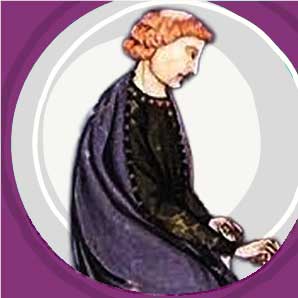
Artist:
Perotin
Born:
1160, Paris
Died:
1230
Who Was Pérotin?
Pérotin (active c. 1200), also known as Perotinus Magnus (Pérotin the Great), was a French composer associated with the Cathedral of Notre Dame in Paris. He is the most famous member of the Notre Dame School of Polyphony and a pivotal figure in the history of Western music. He is credited with expanding early polyphony (music with multiple independent voices) from two voices to three and four, creating a sound of unprecedented grandeur and complexity for his time.
What Is Pérotin Most Famous For?
Pérotin is best known for revolutionizing organum, an early form of polyphony. While his predecessor Léonin composed primarily for two voices, Pérotin introduced organum triplum (three voices) and organum quadruplum (four voices). His most celebrated masterpieces are the massive four-voice works Viderunt Omnes (1198) and Sederunt Principes (1199).
He is also famous for revising the Magnus Liber Organi (Great Book of Organum), adding greater rhythmic precision and structural density to the liturgical repertoire.
What Defined Pérotin’s Musical Style?
In Pérotin’s music the main chant melody is stretched out into long, drone-like notes (the tenor), over which upper voices weave rapid, rhythmic, and interlocking patterns. This required the development of rhythmic modes, the first system in Western music to clearly notate rhythm and meter.
When Was Pérotin Born?
The exact date and place of Pérotin’s birth are unknown, as few personal records from this era survive. Historians estimate he was born around 1160, likely in or near Paris, France. Most of what is known about him comes from the writings of a later English student known only as 'Anonymous IV.'
When Did Pérotin Die?
Pérotin is believed to have died around 1230, though the specific cause and exact date are unrecorded. He vanished from historical documentation in the early 13th century, leaving behind a legacy that essentially invented the concept of musical composition as a complex, architectural craft.
10 Facts About Pérotin
Pérotin (active c. 1200), also known as Perotinus Magnus (Pérotin the Great), was a French composer associated with the Cathedral of Notre Dame in Paris. He is the most famous member of the Notre Dame School of Polyphony and a pivotal figure in the history of Western music. He is credited with expanding early polyphony (music with multiple independent voices) from two voices to three and four, creating a sound of unprecedented grandeur and complexity for his time.
What Is Pérotin Most Famous For?
Pérotin is best known for revolutionizing organum, an early form of polyphony. While his predecessor Léonin composed primarily for two voices, Pérotin introduced organum triplum (three voices) and organum quadruplum (four voices). His most celebrated masterpieces are the massive four-voice works Viderunt Omnes (1198) and Sederunt Principes (1199).
He is also famous for revising the Magnus Liber Organi (Great Book of Organum), adding greater rhythmic precision and structural density to the liturgical repertoire.
What Defined Pérotin’s Musical Style?
In Pérotin’s music the main chant melody is stretched out into long, drone-like notes (the tenor), over which upper voices weave rapid, rhythmic, and interlocking patterns. This required the development of rhythmic modes, the first system in Western music to clearly notate rhythm and meter.
When Was Pérotin Born?
The exact date and place of Pérotin’s birth are unknown, as few personal records from this era survive. Historians estimate he was born around 1160, likely in or near Paris, France. Most of what is known about him comes from the writings of a later English student known only as 'Anonymous IV.'
When Did Pérotin Die?
Pérotin is believed to have died around 1230, though the specific cause and exact date are unrecorded. He vanished from historical documentation in the early 13th century, leaving behind a legacy that essentially invented the concept of musical composition as a complex, architectural craft.
10 Facts About Pérotin
- His name is a diminutive of Pierre, meaning 'Little Peter.'
- He was the first composer to write music for four independent voices (quadruplum).
- He worked at the Cathedral of Notre Dame while it was still under construction.
- He pioneered the use of 'rhythmic modes,' a precursor to modern time signatures.
- His music was written to be performed on high feast days like Christmas and St. Stephen's Day.
- He extensively edited and improved the work of his predecessor, Léonin.
- His compositions are incredibly long for the era, with single words often lasting minutes.
- Virtually nothing is known about his personal life or family.
- His geometric, repetitive style has influenced modern Minimalist composers like Steve Reich.
- He is one of the first composers in Western history to be identified by name.
Top Pieces on 8notes by Perotin