January 15, 2026 | Author: Dominic Nicholas | Category:Repertoire Guides
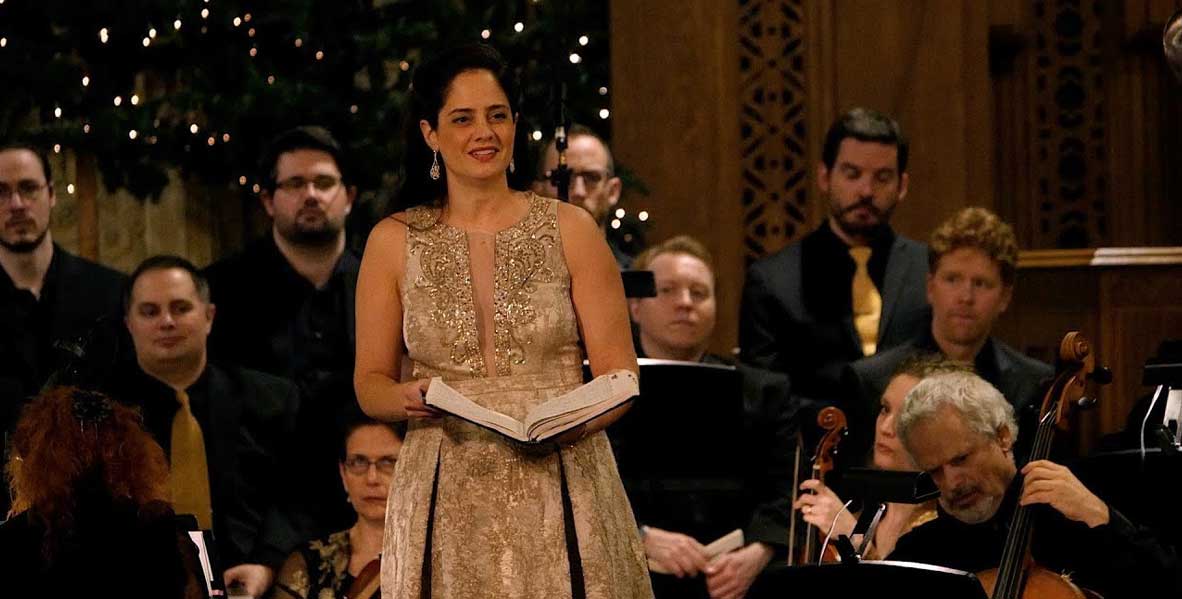
Amanda Powell, soprano
It’s sometimes said that ‘the devil has all the best tunes,’ but if we cast an eye back on the history of Western music, that is very far from being the case. Some of the most gorgeous music ever to have been written is religious. And of this the aria, a work for solo voice, is the purest, most distilled essence of this beauty.
We’ve rummaged through the whole of this history to bring you our picks of the very greatest religious arias, the only rule being that each composer can only be represented by one piece (with one sneaky exception at the end!).
This list is not just for singers; these pieces make great concert pieces on any instrument—follow the links to access our catalogue of exclusive arrangements!
Perhaps the greatest aria from Bach’s greatest choral work, the St. Matthew Passion, a sacred oratorio composed for Good Friday in Leipzig. Scored for alto, solo violin and continuo, it is an intimate moment of remorseful reflection after Peter’s denial of Christ; the text ‘Erbarme dich, mein Gott’ meaning ‘Have mercy, my God.’ The aching suspensions, restrained tempo and weaving interactions between voice and violin make it a supreme expression of penitence.
Laudate Dominum was written as part of a Vespers setting during Mozart’s time working for the Prince Archbishop of Salzburg. For solo soprano, orchestra and chorus, it is music pared down to its absolute and most beautiful essentials—a long arching melody unfolding over a simple pulsing accompaniment, gentle choral entries adding extra support and warmth.
Where other Romantic composers were writing Requiem masses that were filled with music of blood-curdling terror, Fauré chose to emphasise hope, consolation and rest within his own setting. One of the purest expressions of this is the aria ‘Pie Jesu,’ a plea for eternal rest that strips away any kind of operatic gesture in favour of spectral beauty.
One of the composers who wrote a blood-curdling Requiem Mass was Giuseppe Verdi, whose vision of the afterlife, particularly in his terrifying Dies Irae, offers little consolation. Despite this, the work does offer moments of beauty and repose, most especially in the tenor aria Ingemisco tanquam reus (‘I groan as a guilty one’), which balances operatic ardour with sincere supplication.
Handel’s epic telling of the story of Christ is choc-full of great arias, so choosing one from this work is no easy task. ‘I know that my Redeemer liveth’, which opens Part III is, however, special. Built from a clear and noble melody, it unfolds with a calm assurance and profound beauty that is a perfect reflection of the text’s declaration of faith.
Schubert’s famous Ave Maria actually started life as a secular work—it was the third song in his setting of Walter Scott’s 1810 poem ‘The Lady of the Lake.’ Though the religious Latin lyrics were a later addition, they fit the elegantly floating melody perfectly, so it is no surprise that this has become one of the most universally known and loved religious arias.
This work forms the opening movement of Pergolesi’s setting of the Stabat Mater text, a meditation on Mary’s grief at the foot of the cross. For vocal duet, it gets special disposition to be on the list because of its sheer aching beauty, its harrowing suspensions in particular giving it an almost unbearable sense of sorrow and dignity.
This aria marks a moment of repose in Vivaldi’s energetic setting of the Gloria text. It’s charm lies in its naive directness. Accompanied by an obbligato oboe it flows with an effortless grace—devotional without austerity and expressive without excess.
Haydn, a devoted Catholic, was no stranger to writing religious arias. ‘In native worth and honour clad’ is the archangel Uriel’s praise of humanity as God’s crowning achievement in Haydn's setting of the biblical account of Creation. The music radiates balance, order, and joy—qualities that mirror the theological vision of The Creation itself.
Bach, who after all was one of the greatest composers of sacred music, gets a deserved second entry here. Charles Gounod’s famous setting of the Ave Maria superimposes a vocal line over an only slightly modified version of J.S. Bach’s Prelude No.1 in C major from Book I of the Well-Tempered Clavier. The effect is hypnotic, the vocal line unfolding in long expressive phrases over Bach’s masterful accompaniment.