January 12, 2026 | Author: Dominic Nicholas | Category:Repertoire Guides
Brahms Hungarian Dances
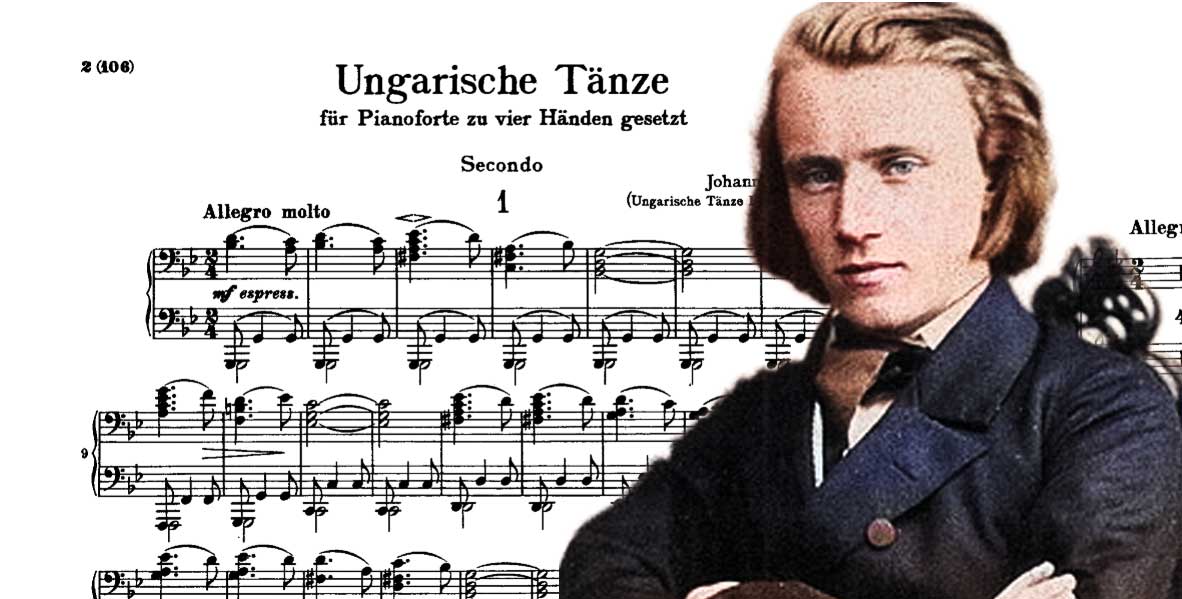
Brahms's 21 Hungarian Dances are amongst the most popular pieces he ever wrote. And of these, No.5 is the undoubted star of the set—fiery, rhythmically incisive and full of dramatic contrasts, it has become emblematic of the 'Hungarian Dance' style. It has also become popular though the many arrangements of it that have been made of it over the years, one of the biggest collections being here on 8notes (we have over 50 versions to chose from!).
The history of this particular dance is, however, controversial to say the least...
The Hungarian Dance Style
The dance style that drives these works derives primarily from the csárdás, a Hungarian dance that emerged in the late 18th–early 19th century. It is characterised by a two-part structure, a slow, brooding or improvisatory lassú that may strongly feature dotted rhythms, and a contrasting friss that is quick and with strong accents, syncopations and sudden dynamics changes. It is a style found, for example in Liszt’s Hungarian Rhapsodies (the most famous being No.2), which were important models and inspiration for Brahms’s set of dances.
Brahms’s Set of Dances
Despite the example of Liszt it is unlikely that Brahms, a German, would have been drawn to the style had not also been for his friendship with Hungarian violinist Ede Reményi. The two performed a number of recitals in the 1850s, the violinist introducing him to this ‘gypsy-style’ music.
Brahms’s set of 21 dances were originally written for piano duet in 1879, though the composer later arranged numbers 1, 3 and 10 for orchestra and the first set of ten for solo piano. Other composers subsequently completed orchestrations of the other dances and solo piano versions of numbers 11-21. The works were an immediate and enduring success and versions for many other combinations of instruments quickly followed.
Arrangements or original compositions?
Of all the works, only number 11, 14 and 16 are original compositions by Brahms, the rest being sophisticated reworkings of existing Hungarian folk music, making them more than mere ‘arrangements.’ Like Liszt’s Hungarian Dances, they take the csárdás as their basic form, often beginning with a slow opening lassú before launching into a vigorous friss. The segmentation is not always quite so clear, however. No.5 for example begins with a vigorous ‘Allegro’ before a ‘Vivace’ much later on. Arguably it is, in fact, all friss and no lassú.
The problematic Hungarian Dance No.5
When writing Hungarian Dance No.5, Brahms accidentally believed he was making use of a traditional folk melody. It was, in fact, an original composition, Bártfai Emlék Csárdás, by Hungarian composer Béla Kéler. A comparison of the works reveals that, though Kéler's work begins with a more traditional lassú, the main theme is, indeed, identical to that used by Brahms:
Kéler resented this appropriation, especially since when performing his own piece people often asked him why his name appeared under a composition that they presumed was by Brahms. In a newspaper article in 1879 he made his annoyance plain:
I am forced to declare that I composed this Hungarian dance in 1858 and also first performed it at that time in Debrecen. In the same year, the dance was published as my piano composition opus 31 by the musical publishing house of Ròzsavölgyi & Co. Sometime around the beginning of 1870, i.e., about 12 years later, Mr. Brahms arranged ten different Hungarian dances, among them, as no. 5, also my above-mentioned dance, for a four-handed piano. Although the accolades which Mr. Brahms has received for the arrangements of these Hungarian dances have been recognised in the musical world for a long time, and I, as a Hungarian, appreciate them and value them that much more, it is also necessary to think of the composer of the original melodies according to the old Latin saying: 'Let justice be done, though the world perishes.’
Despite Brahms’s accidental appropriation of Béla Kéler’s theme, to this day concert programmes credit this work entirely to Brahms. This is not perhaps not surprising given Brahms’s fame completely eclipses that of Béla Kéler. History, as they say, is written by the winners…