March 19, 2026 | Author: Dominic Nicholas | Category:Holidays
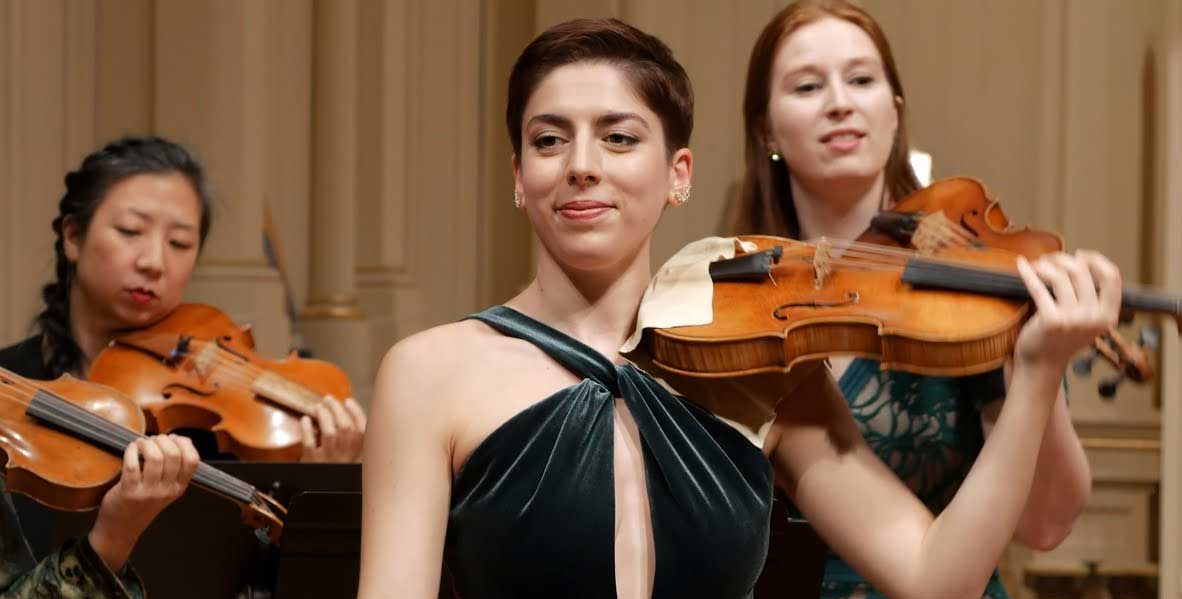
Alana Youssefian, baroque violinist
‘April hath put a spirit of youth in everything’ wrote William Shakespeare; Robin Williams, more prosaically, said that ’Spring is nature's way of saying, 'Let's party!’’ John Keats, actually musing about Autumn, wrote: ‘Where are the songs of Spring? Aye, where are they?’
For our purposes, the answer to Keats is that there are plenty—composers down the centuries have often been inspired by the sense of joy, energy and renewal that comes with spring.
We’ve gazed down those centuries to bring you the very best pieces associated with the season. Some are as familiar as a snowdrop; others as illusive—though just as lovely—as the 30 year bloom of an agave americana.
Antonino Vivaldi—Spring From the Four Seasons (1725)
The most iconic invocation of Spring has to go to Vivaldi’s ‘Spring’, the first concerto of his brilliant Four Seasons. The first and last movement are filled with all of the youthful energy of the season, a reflection of the sonnet text on which they are based: ‘Spring has come with joy/Welcomed by birds with joyous songs.’ The middle movement offers a pleasant moment of repose in a ‘flowery meadow’ accompanied by the ‘soft murmur of leaves and plants.’
Thomas Arne—Where the Bee Sucks, There Lurk I (1746)
Where the Bee Sucks, There Lurk I is a charming song from a composer better known for his patriot tub-thumper ‘Rule Britannia!’ It forms part of the composer’s incidental music written for a production of Shakespeare’s ‘The Tempest.’ Most of this music is now lost, with this lovely song being a lucky and much-loved survivor.
Franz Schubert — Frühlingsglaube (1820)
German composers of song (or ‘Lieder’) had a lot to say about spring. Several works by master songsmith, Franz Schubert, for example fit the bill. There is his joyful ‘Der Frühling will kommen’ (Spring is Coming) from Der Hirt auf dem Felsen, with its wonderfully weaving obligato clarinet part, the more reflective Im Frühling (In the Spring), a bitter-sweet reflection on the nature of memory and lost love and, in Frühlingssehnsucht (Spring Longing), the pain of unfulfilled desire, even as the world blossoms around you.
Perhaps the best-loved of all his spring songs, however, is his Frühlingsglaube, a gorgeous piece characterised by a quiet inner peace as it describes a world awakening:
Robert Schumann— Frühlingsnacht (1840)
That other great mid-century songwriter, Robert Schumann, also penned several fine springtime songs. There is Frühlingsfahrt, (‘Spring Journey’) a journeying song with a deep moral message and the breathlessly ecstatic Er ist’s (‘It is He!’), which describes the exquisite joy felt at the arrival of spring. Loveliest of all, however, is his Frühlingsnacht, one of the most ecstatic songs the composer ever penned, where he describes nature telling him the joyous news that he is loved:
Schumann also explored the subject in another genre. His Symphony No. 1 in B-flat major, Op. 38, known as the ‘Spring Symphony,’ was partly inspired by the seasonal poetry of Adolf Böttger, most notably the line ‘"In the valley, Spring blooms forth!”
Johann Strauss II—Voices of Spring Waltz (1883)
Johann Strauss II’s irresistible Frühlingsstimmen (Voices of Spring), Op. 410, is, perhaps the most celebrated full-orchestra evocation of the season. Written in 1882 at the height of his career, it was originally conceived as a virtuoso vocal piece, though it is now most frequently performed by orchestra alone.
Hugo Wolf—Er ist’s (1888)
Hugo Wolf’s song Er ist’s uses the same Eduard Mörike text set by Schubert. A compact masterpiece it displays a similar kind of breathless joy as Schumann's work, though using a richer, post-Wagnerian harmonic language.
Frank Bridge—Spring Song (1912)
Frank Bridge’s ‘Spring Song,’ the second piece from his 4 Short Pieces for Violin and Piano, is a charming evocation of the season, not in the form of dramatic representations of awaking but rather in its lyrical optimism:
The shattering trauma of World War I would turn Bridge’s music away from such cosy pastoralism, as evidenced by the biting modernism of his subsequent exploration of the season in his orchestral rhapsody Enter Spring (1926/7):
Igor Stravinsky—The Rite of Spring (1913)
And if you are looking for biting modernism, look no further than Igor Stravinsky’s ballet ‘Le Sacre du primtemps’ (‘The Rite of Spring’). The brutally jarring harmonies, revolutionary rhythms and angular choreography caused a riot on its first performance. And rather than saccharine explorations of the joys of spring, the piece teems with earthy representations of nature, ritualistic games and, at the end, the sacrifice of a young maiden, who dances herself to death. Though, more than 100 years later, it still has the power to shock, the piece is nevertheless one of the most exhilarating, life-affirming works of Western music.