April 10, 2026 | Author: Dominic Nicholas | Category:Discover
Paganini
Niccolò Paganini (1782–1840) was not only the greatest violin virtuoso of his generation, he was a phenomena that boggled the minds of contemporary audiences.
His ability to play music of breathtaking complexity, his use of unconventional playing techniques such as left hand pizzicato and extreme harmonics, his uncanny improvising and playing from memory led audiences to feel that they were witnessing not mere skill, but something unnatural or even supernatural—a rumour began to circulate that the composer had made a pact with the devil in exchange for his remarkable skills.
Born in modest surroundings in Genoa, Italy, Paganini began to show great musical promise at an early stage. After a period of study supported by his parents, he toured Italy as a teenage prodigy with his father. There followed a few years of service in the court of Napoleon’s sister, Elisa Bonaparte in Lucca, before, in 1809, he began a period of touring that lasted until 1834. It was during this time that he achieved fame throughout Europe, solidifying his reputation for technical brilliance.
The rumours begin
The first rumours of Paganini being in league with the Devil occur in Vienna in 1828. During a performance of his Witches’ Dance an audience member attested that he ‘distinctly saw the devil close to the violinist, guiding his fingers and directing his bow; the said devil was dressed in red and had horns and a tail, and the striking likeness of the countenances of the two, plainly proved the relationship between them.’
This story and others like it followed Paganini wherever he went, upsetting the great violinist so much that he appealed to the press to help him to refute the rumours. He even went so far as to publish a letter from his mother as proof that he was not the son of the devil.
Appearance is everything
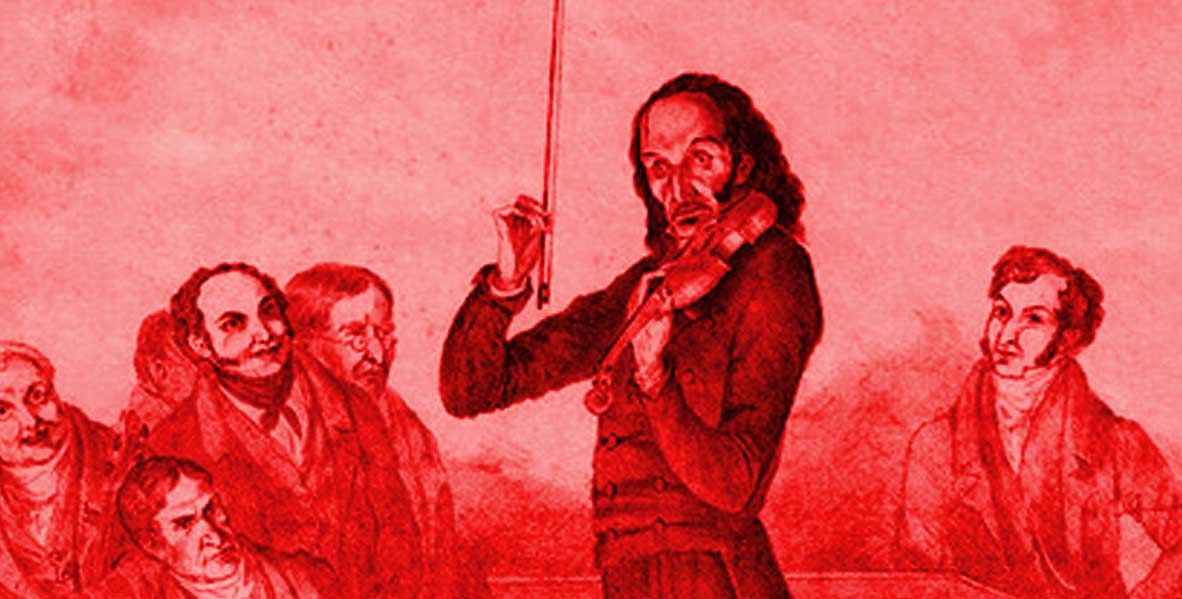
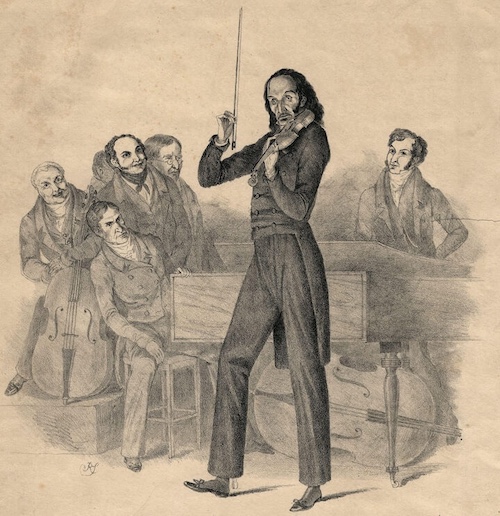
It is possible that Paganni’s appearance didn’t help. By the late 1820s he was no longer a romantic-looking youth but 46, skeletally thin with a pale complexion, long black hair and with an intense, brooding stage presence. Whilst it is not clear that he suffered from the oft-theorised Marfan or Ehlers-Danlos syndrome, Paganini was certainly no stranger to chronic illness and had a punishing and extravagant lifestyle, which had no doubt produced this gaunt appearance. To audiences of the time, however, this look only made him look even more like a figure straight out of a gothic novel.
Paganini in 1831 [Source: Wikipedia]
The 24 Caprices
The 24 Caprices, Op.1, his most famous work, are a set of 24 virtuosic works for the instrument, written somewhere between 1802-17 and published in 1820. Though only one of Paganini’s many works he wrote for himself to play, they became the embodiment of his style and also, in a sense, the ultimate evidence of his diabolical genius.
Each movement is a short study for unaccompanied violin that focuses on a specific extreme technique. Many of these left audiences stupefied.
No. 5, with it’s blazing speed, for example sounded frankly impossible:
Caprice No. 13 focuses on scale like passages using double stops high speed runs and, in the second part, flexibility, position shifting, string changing and détaché bowing. Appropriately enough, it earned the nickname the ‘Devil's Laughter’ or ‘Devil's Chuckle’:
Most famous of all is Caprice No. 24, a theme followed by a set of fiendish variations:
This proved hugely influential, with many subsequent composers making their own set of variations on Paganini’s theme, including Brahms' Variations on a Theme of Paganini Rachmaninoff’s Rhapsody on a Theme of Paganini, Boris Blacher’s ‘Paganini-Variationen’ and Andrew Lloyd Weber’s ‘Variations.’
Paganini’s slow interment
The rumours around Paganini followed him to his—eventual—grave. He died from internal haemorrhaging in Nice, France on 27th May 1840 before a priest could be summoned to perform last rites. This, combined with the rumours about his association with the devil led the church to refuse him a Catholic burial. Though his body was returned to Genoa four years later following interventions with the Pope, it was not until 1876 that he was finally interred in a cemetery in Parma.
Paganini’s Legacy
Paganini’s legacy is three-fold. As a player he brought esoteric techniques into the mainstream, his extreme virtuosity raising the bar for violins that followed. As a composer his works embody these advances in technique; they are key works in the formation of any virtuoso violinist’s technique and a huge source of inspiration for composers.
The third part of his legacy concerns his reputation as a romantic artist. The whiff of diabolical mystery that accompanied his life and death made him a gothic-romantic figure, inspiring many dramatic portrayals of his life, including in the films ‘The Magic Bow’ (1946), ‘Kinski Paganini’ (1989), and ‘The Devil's Violinist’ (2013); in Don Nigro's satirical play ‘Paganini’ (1995); and in the music ‘CROSS ROAD ~The Devil's Violinist Paganini’ (2022).