February 24, 2026 | Author: Dominic Nicholas | Category:Repertoire Guides
Elgar, Caroline Roberts, Esther Abrami
Though not Elgar’s first well-received piece, Salut d’Amour ('Love's Greeting’) was undoubtedly his first viral hit. After its publication in 1889 the work became wildly popular amongst amateur and professional musicians alike, a process helped by its subsequent adaption for many instrumental combinations.
The story of the work is charming, though not with out a bitter edge—written as present for his fiancee, it was a gift that financially continued to give, though not in a way the composer might have hoped.
A controversial affair
Long before his knighthood, his Pomp and Circumstance marches, symphonies and international fame, Elgar was a struggling musician in rural Worcestershire. Largely self-taught, he had struggled to find any kind of entry into the music profession, initially working as a clerk in a local solicitor’s office before making ends meet through giving piano and violin lessons.
One of these pupils was Caroline Alice Roberts, known simply as Alice. 9 years his senior, she was a published author and from a much more respectable social background. The two fell in love and became engaged, much to the horror of Alice’s family, for whom Elgar was not only a rural nobody, but, worse, a Roman Catholic rural nobody.
Alice was disinherited, a fact that she bore with some grace, instead dedicating her life to helping Elgar realise his genius.
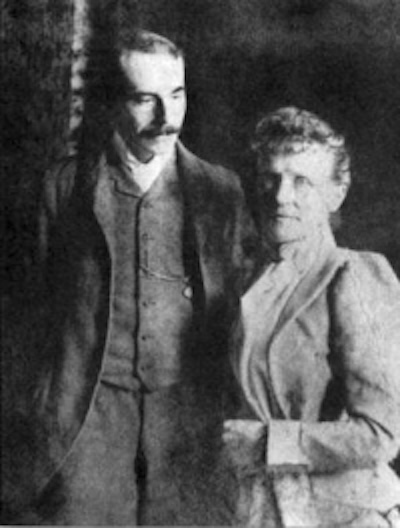
Edward and Alice Elgar, c.1891
A token of love
On their engagement Alice had written Elgar a poem entitled ‘The Wind at Dawn,’ which the composer had set to music. As his own engagement gift to her—some have speculated because he could not afford to buy her one—he presented her with another new piece. This was ‘Salut d’Amour’, though the original title was in German, ‘Liebesgruss’, a recognition of Alice’s fluency in the language. It bore the dedication in French ‘à Carice ‘ (‘to Carice'), a contraction of the names ‘Caroline Alice,’ the name they would also give to their daughter, born two years later.
Performance and publication
The first performance of the work was the version for orchestra in November 1889 at Crystal Palace, conducted by August Manns. Besides this, the work also existed in arrangements for violin and piano, piano solo and for cello and piano. In the same year Schott and Co. agreed to publish all of these.
Salut d'amour, violin and piano version:
The initial sales of the piece, still titled ‘Liebesgruss’, were not promising until Schott changed the work’s name to the now familiar ‘Salut d’Amour’, the German being relegated to a subtitle. This helped the work to become appealing in more European countries. It marked the beginning of the work’s huge popularity.
Why the piece is popular
The popularity of the work was not, of course, due to the title alone. The piece sits perfectly between drawing-room charm and genuine emotional warmth. Its finely made melody unfolds in memorable vocal-like phrases, the harmony is rich but unsentimental, the accompaniment supports but does not overwhelm the melody. The work is also rewarding for a wide range of musicians; amateurs could play it, professionals could shape it. And all of these characteristics, plus its brevity—the playing time is around three minutes—meant that audiences could immediately understand it.
Realising that the piece had hit upon a winning formula, Elgar later tried to emulate it by composing a companion piece, Mot d’Amour. Though hauntingly beautiful and even superior in construction to the earlier work, it did not, however, catch on quite like ‘Salut.’
Mot d'amour, for violin and piano:
Artistically, not financially rewarding
Unfortunately for Elgar the popularity of ‘Salut d’Amour’ did not bring any direct financial reward. On its publication Elgar had sold the piece outright to the publisher for just two guineas, so all the royalties went to Schott and Co.
The work did, however, serve a greater purpose. In becoming one the most widely played miniatures ever written the work introduced Elgar’s voice to a much wider audience. Artistically then, this small work, written as an act of love, did indeed become the gift that kept on giving.