April 15, 2026 | Author: Dominic Nicholas | Category:Discover
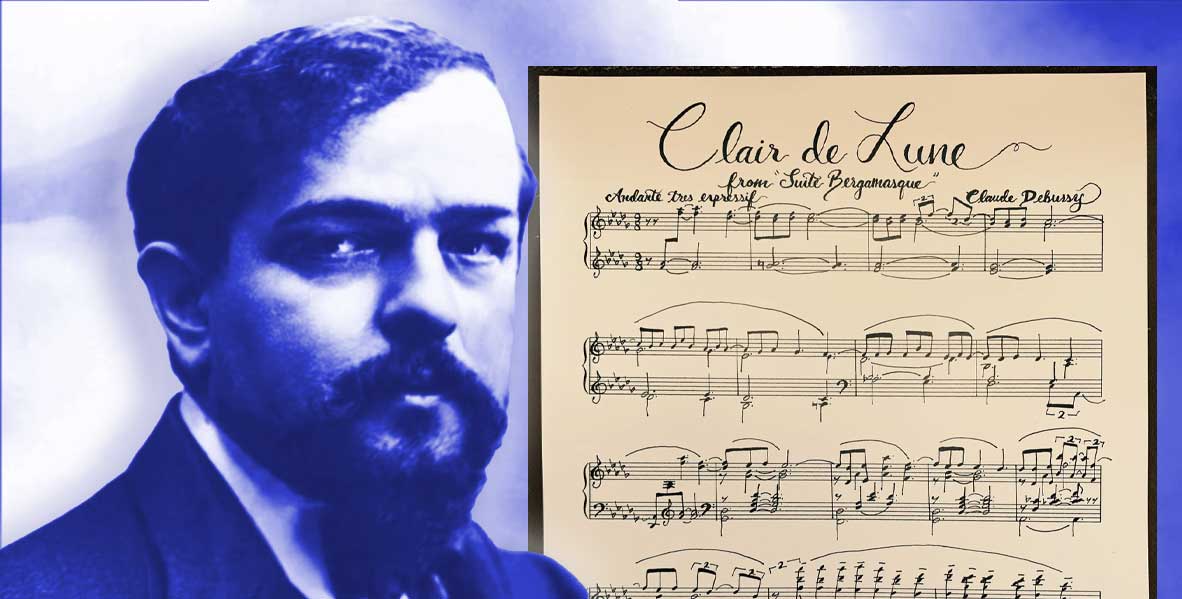
Debussy and the manuscript for Clair de Lune
Debussy’s four movement Suite Bergamasque, published in 1905, is not just one of his best-loved pieces, but one of the most familiar in all piano repertoire. This is partly due to the popularity of its third movement, Clair de Lune, which has been widely played, adapted in popular culture and arranged for many different ensembles over the years (you can find numerous versions of this iconic movement to play here on 8notes).
Yet Debussy himself hesitated to publish this work and was likely ambivalent about its phenomenal success.
Background
It’s tricky to unravel the composition timeline of Debussy’s Suite Bergamasque. We do know that the original version of it was begun in 1890, when the composer was 28. There must have been some complete movements, since in 1905 an offer was made to publish the work. Debussy was initially reluctant, his style having developed considerably in the intervening years with the composition of era-defining works such as Prélude à l'après-midi d'un faune,Pelléas et Mélisande and La mer.That he eventually agreed, however, does suggest a certain fondness for these pieces.
Assembling the Suite
Though it is not clear if Debussy went so far as to compose more music, perhaps even an entire movement, when assembling the suite, he probably made some revisions and certainly altered the name of two movements—‘Passepied’, was originally called ‘Pavane’, whilst ‘Clair de Lune’ had been ‘Promenade sentimentale.’
What is a Bergamasque?
A Bergamasque was originally a rustic and comic dance originating from Bergamo, Italy, but Debussy’s reference to this is oblique. The title of the third movement ‘Clair de Lune’ comes from Verlaine’s poem of the same name, which also includes a reference to ‘masques et bergamasques,’ likely leading him to the title. Whilst not exactly rustic, there is, however, a certain kind of innocent charm to the work that makes the title seem to fit its contents.
The Suite
The suite consists of four movements that show a lingering affection for earlier idioms, most notably the Baroque suite and its associated dances. Its movements are also marked by a clear sense of structure and an ornamental elegance that Debussy outgrew as his style matured.
1. Prélude— beautiful snaking melodies with rich diatonic harmony. Think Bach’s Overturefrom Orchestral Suite No.1 heard through a French romantic aural prism.
2. Menuet— Debussy takes us a long way from the Baroque form by obscuring the underlying 3/4 meter. Lots of delightfully rococo and somewhat sardonic embellishments.
3. Clair de Lune— the movement that everyone knows and every pianist want to play. It certainly is magical, unfolding with enormous restraint, its soft spacious chords more revealed than played, its rhythms seeming to suspend time. Modern performances emphasise these qualities, especially by choosing a very slow tempo.
Yet it is possible we are all getting it working—there exists a performance by Debussy of this movement recorded onto a piano roll in which his choice tempo is much faster, the rhythms everywhere a little more defined and where stormy elements are emphasised:
4. Passepied— a fast movement based around a type of dance that originated in Brittany. The texture consists of a continuous stream of quavers, over which Debussy introduces subtle shifts in harmony, tonality and meter (especially by overlaying triplets over groups of four quavers):
Legacy
Whilst movements 1, 2 and 4 of Suite Bergamasque are well-loved in their own right, there is no denying that the popularity of the work owes much to its third movement, Clair de Lune.
It has been embraced in popular culture, gracing, for example, many a film. In 'Twilight' (2008) is it used to encapsulate the subtleties of love, whilst in the 'The Right Stuff' (1983) it provides serene contrast to the main action. In an extended scene in 'Ocean’s Eleven' (2001), on the other hand, it is used to suggest the bittersweet emotions of the heist crew as they reflect upon their success by the Bellagio fountains in Las Vegas:
It has even been used in advertising, subtly emerging during the course of Baz Luhrmann’s 2004 Chanel No.5, ‘Le Film’:
It’s impossible to know what Debussy would have made of all this. One suspects, however, that he might not have been entirely displeased. Suite Bergamasque may be an early and unrepresentative work, but it is a masterpiece nevertheless. And, more than that, it is for many people a starting point for discovering the full richness of the composer’s mature voice. In that respect, at least, this wonderful work has served the composer very well indeed.