May 1, 2026 | Author: Dominic Nicholas | Category:Piano | Instruments
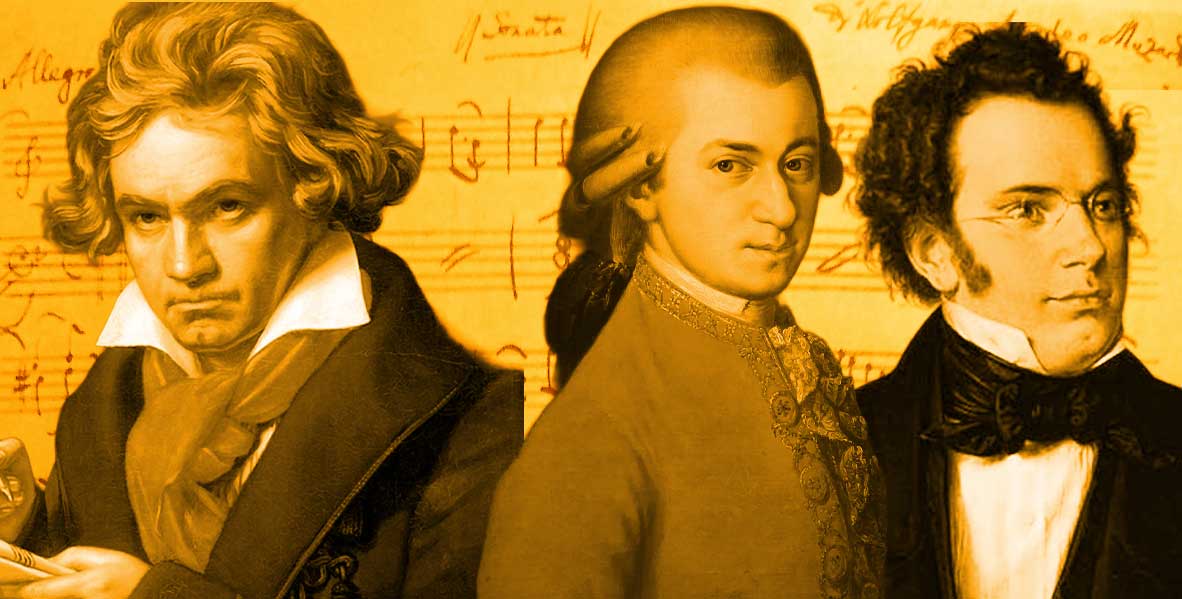
Beethoven, Mozart, Schubert
Given that many composers’ primary instrument is the piano, it is hardly surprising that one of the richest seams in classical music is the piano sonata. The sonata—a three or four movement work, similar in form to a symphony though more intimate in expression—has been the repository of some of the most profound artistic expression since its emergence in the Classical period.
Choosing the top 10 piano sonatas is an onerous task. To make things democratic, and to give a good stylistic spread, we’ve mostly limited each composer to one entry. The only exception is Beethoven, whose exceptional works could make a list all of their own.
As always, follow the links to find the complete sheet music, including, where appropriate, some of our exclusive arrangements. These include arrangements for instruments other than the piano, so you don’t have to be a pianist to enjoy these great works.
Pianist Artur Schnabel famously said that Mozart is ‘too easy for children, but too difficult for professionals’, this piece being an excellent example of that adage. Mozart himself described it as ‘for beginners’ but this is deceptive—it is, like so much Mozart, a work of crystalline perfection, the thin textures giving the soloist nowhere to hide. It contains one of the most familiar first movements in any piano sonata and a gloriously lovely slow movement. Unsurprisingly it has become of the most widely taught and most popular works in the repertoire.
Haydn did so much to perfect the form of the sonata, both in his symphonies and in his keyboard works. His final sonata, with its bold contrasts, quasi-orchestral textures and absolute structural mastery, further expands the expressive and technical range of the form, presaging the innovation and expansions that would occur in the hands of Beethoven.
Is there any sonata more famous than the Moonlight Sonata? Its iconic first movement breaks all the rules by being slow, not fast and, instead of prioritising musical argument, it is instead all atmosphere—marking, at a relatively early point in the century, a decisive shift towards romanticism. Its last movement, explosive in character and hence a complete contrast to the opening, also redefines concepts of balance.
If the Moonlight Sontata is one small Romantic-era step, then the Hammerklavier is one giant leap. One of the the most ambitious and technically challenging sonatas ever to have been written, it is a work of unprecedented length and scale, the slow movement alone lasting longer than some classical sonatas. It pushes the form as a whole and its sub-forms, most notably the frenetic last movement fugue, towards breaking point.
Written just months before his death, Schubert’s Piano Sonata in A major, D.959 forms the second of a final trilogy of piano sonata masterpieces. Like Beethoven’s Hammerklavier, it is epic in scale, though here the emphasis is on lyrical expansiveness and the cycling of architectural themes. The slow movement, for which the work is especially known, begins as a sorrowful and hypnotic barcarolle, but explodes into violent, improvisatory central section that contains some of the most shockingly modern and terrifying music of the 19th century.
Schumann offers yet another take on the early Romantic sonata. It is an intensely personal work—Schumann published the first edition of it under the pseudonyms ‘Florestan and Eusebius’, representing conflicting sides of his personality, Florestan being fiery and passionate, Eusebius being the dreamy introspective poet. These conflicting personalities define the work’s radical form, where instead of smooth transitions musical ideas are connected through sudden shifts in mood, abrupt pauses, and as an emotional stream-of-consciousness. It is also a love-letter to his future wife Clara Wieck, the opening movement based on a dance theme by her, the lovely second movement a transcription of Schumann’s own love song An Anna.
Chopin’s Piano Sonata No. 2 in B-flat minor is so much more than its famous and now ubiquitous funeral march third movement (read more about this in our complete article What is the story behind Chopin's funeral march?). It offers an extraordinary sequence of movements that, in their wild variety, seem barely to fit together. There is a sonata form first movement with a conventionally stormy main theme and serene second subject; a scherzo that recalls Beethoven but with a singing trio that is pure Chopin; the morbidly lugubrious funeral march; and a curiously fleeting finale, all in octave triplets. Though this has caused one critic to label it ‘not more a sonata than it is a sequence of ballades and scherzi,’ in some curious way it does all hang together.
Franz Liszt’s monolithic Piano Sonata in B minor is a hugely important work in the development of the Romantic-era sonata. Formally it is radically innovative, employing a kind of structure within a structure. The whole work is in one continuous 30 minute sonata movement, but with subdivisions that also reflect the traditional four movement subdivision of a classical sonata. Within this there is a masterful handling of thematic transformations, the whole being built on five core musical cells heard in the opening pages. It also represents a new pinnacle in virtuosity, requiring ferocious octaves, interlocking leaps, and blinding speed. This is not show for show’s sake, however; it is all in service of a narrative that some have viewed as a musical retelling of Goethe's Faust, in which the clashing themes represent specific characters locked in a cosmic battle.
Sergei Rachmaninoff’s Piano Sonata No. 2 represents the final and most ferocious display of late-Romantic piano music. Though in three separate movements, like Liszt’s Sonata in B minor, it is cyclical in its handling of themes, the first movement falling motif returning in different guises in the second and third movements. It is a benchmark test for concert pianists, requiring massive chord reaches, rapid-fire hand crossing and the picking out of single melodies from within dense polyphonic textures.
It is also a problematic in one sense—fearing that the work was too long, dense and difficult, Rachmaninoff revised it in 1931, the texture becoming leaner, the whole 120 bars shorter. Both versions have their proponents with the great Vladimir Horowitz even creating (with Rachmaninov’s approval) a hybrid version of the two, which many pianists still play.
If Rachamninoff is the Indian summer of the romantic sonata, then Berg’s Piano Sonata 1 represent the first bloom of modernistic spring. Written after a period of study with Arnold Schoenberg, Berg floods the texture with such high levels of chromaticism as to render its nominal key of B minor almost redundant. The work is also a fine example of what Schoenberg termed ‘developing variation’, deriving an entire piece of music from a single, tiny musical seed—virtually every melody, transition, and dense chord in the piece can be traced back to the very opening three-note gesture, making it a masterclass in musical economy.